Sep 29, 2026
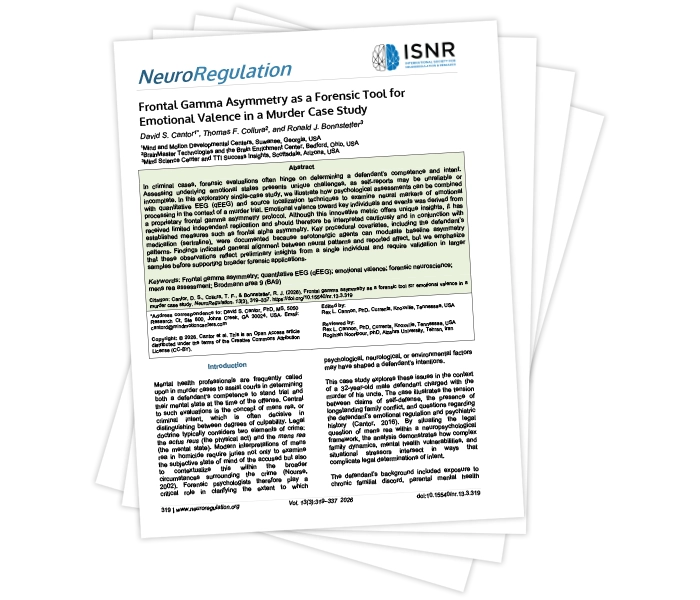
In this exploratory single-case study, we illustrate how psychological assessments can be combined with quantitative EEG (qEEG) and source localization techniques to examine neural markers of emotional processing in the context of a murder trial. Emotional valence toward key individuals and events was derived from a proprietary frontal gamma asymmetry protocol. Although this innovative metric offers unique insights, it has received limited independent replication and should therefore be interpreted cautiously and in conjunction with established measures such as frontal alpha asymmetry.

Nov 3, 2025
From the outset, Scholz’s writing is accessible, encouraging, and infused with authenticity. It’s no surprise that early readers—ranging from corporate executives to coaches—praise the book for its blend of actionable insights and personal storytelling.

Nov 3, 2025
Michael and Robert anchor their ideas in the brain’s architecture—what they call “leading with your upper brain.” The prefrontal cortex, our upper brain, governs executive functions such as planning, emotional regulation, and moral reasoning. In contrast, the limbic system, or “lower brain,” is reactive, impulsive, and fear-driven.

Jun 26, 2025
The EQ technical manual contains information on the history and development of emotional intelligence from its beginnings to the current implementation of the concepts as psychometric assessments. Included in this manual are a host of statistical and psychometric analyses used to establish evidence of the validity and reliability of the TTI Success Insights EQ assessment. Version 1.2 includes adaptation analyses for the United Kingdom and Australian versions, as well as analysis for the German EQ adaptation.

Jun 17, 2025
As digital transformation accelerates, power utilities must adapt by developing both technical and human capacities. This study focused on one electric cooperative, using data from all 102 employees to assess leadership readiness. By comparing this group to 162 engineering managers and 28 C-suite executives, the research identified key gaps in competencies such as opportunity recognition, creative problem solving, and futuristic thinking. Using three dimensions—personal/professional competencies, behavioral leadership styles, and motivational drivers—the analysis revealed areas for development. Recommendations are aligned with the Engineering Management Body of Knowledge (EMBOK) to help build a stronger, future-ready talent pipeline.
